
SEO vs AIO vs AEO vs GEO: What You Should Focus On in 2026
Veronika Mostovaya / 02.27.20261263
SEO vs. Geo vs. AEO vs. AIO is no longer just a theoretical debate – it reflects how search visibility is evolving in real time. Businesses must now adapt to AI-driven discovery alongside traditional rankings.
In this article, we break down how search is changing, what each optimization model means, and what you should prioritize in 2026 to stay visible where users actually look.
How Search Is Changing in the Age of AI
The conversation around AI search optimization vs. traditional SEO is growing because user behavior has fundamentally shifted.
Two major changes are noticeable:
- From clicking search results to receiving instant AI-generated answers
- From link-based discovery to answer-based discovery
AI-powered systems like ChatGPT, Gemini, Perplexity, and Google AI Overviews summarize information directly. Instead of reviewing ten blue links, users now get synthesized responses in seconds.
This transformation affects:
- Organic traffic patterns
- Click-through rates
- Brand visibility
- Content strategy
Visibility is no longer limited to ranking on page one. It now includes appearing inside AI-generated responses.
Why SEO Still Matters in 2026
When discussing SEO in 2026, it's important to clarify something: SEO is not dead. It has simply evolved.
In simple terms, SEO (Search Engine Optimization) focuses on:
- Ranking in search engine results pages (SERPs)
- Driving organic traffic
- Optimizing keywords, content, backlinks, UX, and technical performance
SEO still performs best when:
- Users are actively comparing products
- Local search intent is strong
- Transactional queries dominate
- Industry competition relies on traditional search results
Based on experience at our web studio, strong technical SEO and content optimization continue to drive consistent organic traffic – especially in competitive industries and local markets.
However, SEO now plays a foundational role. It builds discoverability and authority, but it is no longer the only visibility channel.
What Is AIO (AI Optimization)?
Many businesses now ask: what is AIO vs. SEO, and how does AI search engine optimization work?
AIO (AI Optimization) focuses on optimizing content so AI systems can clearly understand, interpret, and contextualize it.
AIO prioritizes:
- Clear content structure
- Entity clarity (who, what, where)
- Context-rich explanations
- Machine-readable and human-readable formatting
AIO helps AI models understand:
- What your content is about
- Who created it
- Why it is trustworthy
In practical terms, AIO ensures AI systems can interpret your content accurately – which is essential for both AEO and GEO to function effectively.
Think of AIO as the bridge between traditional SEO and AI-driven discovery.
What Is GEO (Generative Engine Optimization)?
If you're wondering what is generative engine optimization, here's the core idea:
GEO (Generative Engine Optimization) focuses on influencing AI-generated responses – not just ranking as a link. As AI answers reduce clicks and replace traditional search results, GEO becomes critical.
What is the difference between GEO vs. SEO? Here are the key points:
- SEO ranks pages in SERPs
- GEO increases the chances that your brand is included, cited, or referenced inside AI-generated answers
In our client work, we've seen instances where brands appeared in AI-generated summaries despite not ranking in the top three organic results. That visibility would not have happened through traditional SEO alone.
GEO depends on:
- Strong authority signals
- Structured, clear information
- External mentions and citations
- Consistent entity recognition
It's about influencing the output of generative systems.
What Is AEO (Answer Engine Optimization)?
The answer engine optimization (AEO) definition centers on optimizing content to appear in direct answers rather than traditional link listings.
Understanding AEO vs. SEO differences is key:
- SEO aims for ranking
- AEO aims for direct answer inclusion
AEO focuses on:
- FAQ sections
- Tables
- Lists
- Concise explanations
- Clear headings
These elements help content appear in:
- Google Featured Snippets
- Answer Boxes
- People Also Ask
- Voice assistants (Siri, Alexa)
- AI tools like Bing Chat and Perplexity
AEO sits between SEO and GEO. It optimizes for structured answer visibility within both traditional and AI-enhanced search environments.
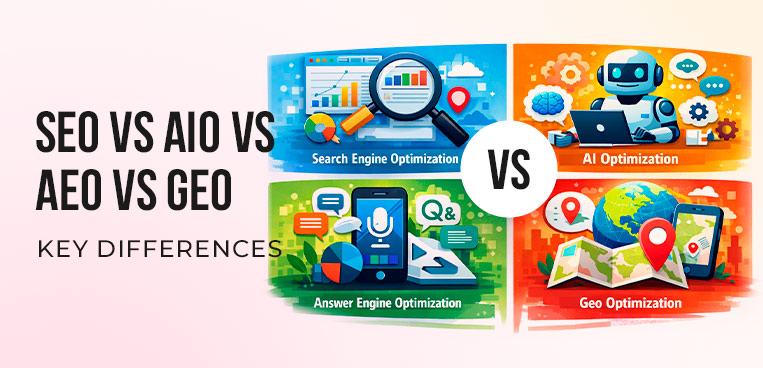
SEO vs AIO vs AEO vs GEO: Key Differences
The debate around SEO vs. AEO vs. GEO vs. AIO and SEO vs. GEO vs. AEO often creates confusion. The reality is that these approaches solve different visibility problems at different stages of the user journey – here's a nice comparison table to help you distinguish between all these “eeh-ouhs”.
| Aspect | SEO | AIO | AEO | GEO |
|---|---|---|---|---|
| Primary goal | Rank pages, drive organic traffic | Ensure AI correctly interprets content | Appear in direct answers / featured snippets | Be included, cited, or referenced in AI-generated responses |
| Where visibility happens | Search Engine Results Pages (Google, Bing) | AI interpretation layer (internal, not visible to users) | Featured snippets, Answer Boxes, People Also Ask, voice assistants | AI answers on generative platforms (ChatGPT, Perplexity, Gemini, Bing Chat) |
| What is being optimized | Pages, keywords, links, technical SEO | Structure, context, entities, clarity | Structured answers, FAQ sections, concise explanations | Citations, authority signals, entity recognition, references used by AI models |
Each approach targets a different layer of search visibility.
How SEO, AIO, AEO, and GEO Work Together
This is where strategy becomes critical.
Across our projects, we've seen that SEO alone rarely drives visibility in AI-generated answers. Pages ranking well in Google do not automatically get referenced in AI summaries.
For example:
- Some client pages appear in AI-generated summaries despite not ranking in the top three Google results.
- Others rank well but are ignored by AI systems due to unclear structure or weak authority signals.
These approaches are not competitors. They are layers of one strategy:
- SEO builds the foundation
- AIO ensures AI-readability and contextual clarity
- AEO improves direct answer visibility
- GEO increases inclusion in generative responses
This layered strategy is increasingly part of modern AI engine optimization frameworks.
As a local SEO agency in Canada, we've also observed that regional brands benefit significantly when combining local SEO authority with structured AI-friendly content. These are among the best examples of AI visibility optimization we've seen in practice.
Practical Steps to Optimize for SEO, AIO, AEO, and GEO
Implementing effective AI search engine optimization techniques requires a structured approach. Here are actionable AI search engine optimization strategies:
1. Strengthen SEO Fundamentals
- Improve technical SEO
- Optimize page speed
- Build relevant backlinks
- Target clear search intent
2. Improve Content Structure (AIO)
- Use structured headings
- Define entities clearly
- Add contextual explanations
- Ensure consistent authorship and brand signals
3. Implement AEO Tactics
- Add FAQ sections
- Use tables and lists
- Provide concise definitions
- Answer common questions directly
4. Monitor AI Visibility (GEO)
- Check how your brand appears in AI-generated responses
- Track citations in generative platforms
- Strengthen authority via digital PR and expert mentions
5. Demonstrate E-E-A-T
- Highlight author expertise
- Showcase experience
- Build authoritative references
- Maintain trust signals
Structured authority is becoming as important as keyword optimization.

What You Should Focus On in 2026
In real-world projects we've handled, combining SEO fundamentals with AI-friendly content has consistently improved visibility across both traditional and AI-driven environments.
No single approach – SEO, AIO, AEO, or GEO – works in isolation anymore. In 2026, we've got the following picture:
- SEO builds discoverability and authority
- AIO ensures AI systems correctly understand and interpret content
- AEO drives direct answer visibility
- GEO increases the chances of being included in AI-generated answers
Businesses that treat these as separate strategies risk fragmented visibility.
At Zwebra, we approach search as a unified ecosystem. As a generative AI search engine optimization agency working with brands across industries, we focus on aligning traditional optimization with AI-ready content architecture.
Search visibility in 2026 is no longer about ranking alone – it's about being understood, trusted, and referenced wherever answers are generated.
